Every week, a business owner tells me they have started using AI. What they mean is they bought a tool. Maybe three. A writer here, a chatbot there, something that makes images.
Then I ask one question. Does any of it talk to the rest of your business? The answer is almost always no. The tools sit in separate tabs. The owner is still the glue holding it all together.
That is not an AI business. That is a person with more tabs open.
The real problem is not the tools
Most companies do not have a marketing problem. They have a systems problem.
Leads come in through one channel. Follow-up lives in someone's head. Content gets made when there is time, which means rarely. Reporting is a screenshot sent on a Friday. Each piece works on its own. None of it works together.
AI does not fix that by itself. Bolt a smart tool onto a broken process and you get a faster broken process. You move the mess around quicker. The owner is still the bottleneck, just a more tired one.
The fix is not another tool. It is a system the tools plug into.
What an AI Operating System actually is
Think about how an operating system works on your computer. You do not manage memory or talk to the hard drive by hand. The OS handles all of that underneath. You just do your work on top of it.
An AI Operating System does the same thing for a business. Every department gets its own AI layer built for the job it does. Those layers feed into one shared core, so the whole company runs on the same information instead of a dozen disconnected apps.
Marketing is where most owners feel the pain first, so that is where we start. We build it in four layers.
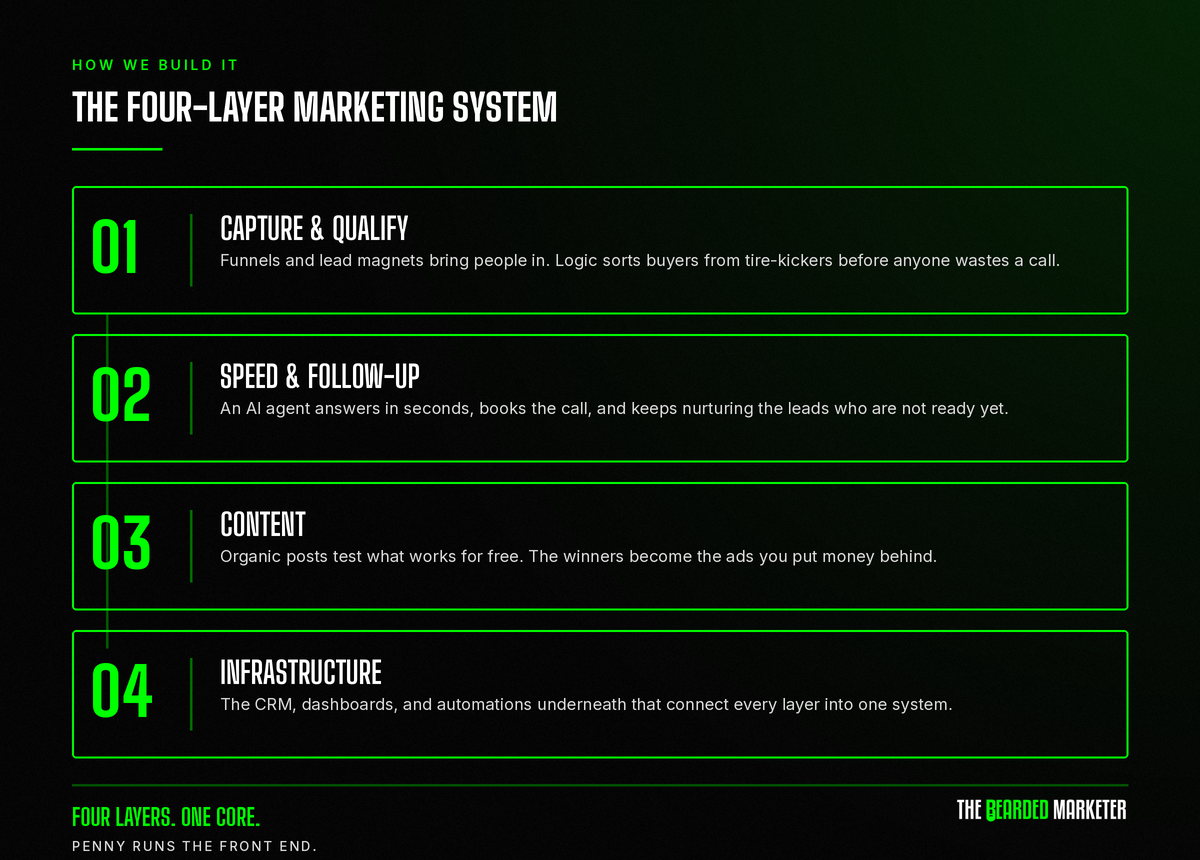
Layer one is capture and qualify. Front-door funnels and lead magnets bring people in, and simple logic sorts the serious buyers from the tire-kickers before anyone wastes a phone call.
Layer two is speed and follow-up. The moment a lead raises a hand, an AI agent answers, books the call, and keeps nurturing the ones who are not ready yet. No lead sits cold while you are busy.
Layer three is content. We treat organic social as a free testing lab. The posts that earn attention are the ones we put money behind. You stop guessing what to run as an ad because the audience already told you what works.
Layer four is the infrastructure underneath. The CRM, the dashboards, the knowledge base, the automations that connect it all. This is the part nobody sees and the part that makes everything else hold together.
The humans still run the show
The AI hype crowd skips this part. The system handles volume. People handle judgment.
The system can send a thousand follow-ups, sort a hundred leads, and draft fifty posts. It cannot read the room on a hard client call. It cannot decide which risk is worth taking this quarter. It cannot care about your customer the way a person can.
So we automate the work that repeats and protect the work that needs a human. You stop spending your day on tasks a system should own. You spend it on the decisions only you can make.
That is the Disney idea underneath all of this. Disney does not have customers. It has guests. The reason that feeling is so consistent is that the machinery behind the scenes is built so well the magic out front never breaks. Great systems are what make a great experience possible.
Why this matters right now
We are in what I call the Interest Media era. The algorithm does not care how many followers you have. It shows your content to the people most likely to care about it. A brand new account's third post can beat a brand with a hundred thousand followers if the content is more relevant.
That changes the game for small and mid-sized businesses. You no longer need the biggest audience. You need the best system for making relevant content, proving what works, and putting money behind the winners. The owner with the better operating system wins, not the one with the bigger name.
The companies building this now will have a head start that is very hard to close later. Not because they bought AI first, but because they organized around it first.
Where Penny comes in
Every operating system needs a face. Ours is Penny.
Penny started as our dog, a Miniature Schnauzer with a green collar and a stubborn streak. She has grown into the front-end of everything we build, the voice that answers your calls, greets your leads, and runs the system underneath. Same heart, bigger mind. The dog is the heart. The system is the mind.
Start with one layer
You do not build the whole thing on day one. You start where the bleeding is worst.
For most businesses that is speed-to-lead, because slow follow-up quietly kills more deals than anything else. Fix that one layer, prove it works, then add the next. That is how an operating system gets built, one working piece at a time.
If you want to see which layer is costing you the most right now, that is exactly what we map on a short call. No pitch, no pressure. Just a clear look at where your system leaks and what to fix first.
Book a free 15-minute callPrepared by: The Bearded Marketer. AI-Powered Marketing Systems. Disney-Level Experience.